Accommodating / Next Generation

Showing all 14 results

Crystalens Advanced Optics Accommodating IOL (Bausch+Lomb)

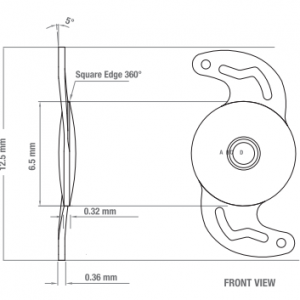
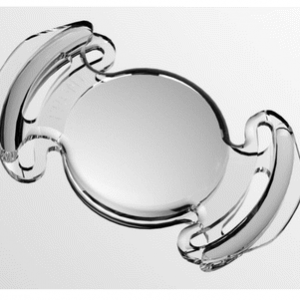
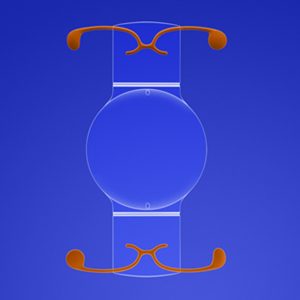
Based on the Crystalens Platform -Embedded Polymide haptics into the hinged Silicone Plate of the IOL. with Aspheric Optics.  B+L will supply AO1UV (11,5mm) and AO2UV (12,0) for smaller/hyperopic and larger/myopic eyes respectively  (From +17 0 to +27.0 in 0,25D steps!)

Fluid Lens Accommodating IOL (PowerVision)

The FluidVision® Accommodating Intraocular Lens

Accommodation refers to the eye’s ability to dynamically adjust focus for clear vision at all distances. The FluidVision accommodating IOL from PowerVision contains a tiny amount of fluid inside the lens that moves in response to the natural muscle forces in the eye. The FluidVision lens provides True Accommodation™ by mimicking the eye’s natural accommodative process, changing shape and becoming thicker when the patient needs to see up close or thinner to see far away.  (from Powervision Website)

Unlike the Nulens and the Lumina this 3rd investigational Device meant to change the Curvature in vivo is meant to be placed in the capsule. 

Gemini Refractive Capsule (Omega Ophthalmics)


This Device is designed to protect the Crystalline Space for current and future applications. Replacing the 260mg cataract with our current  15mg implant technology might not be the right solution for the future. It may even survive the era of Refractive Indexing. (Possible applications with Augmented Reality/ Zooming and Drug delivery Reservoir.


https://www.youtube.com/watch?v=-k7e5ZZNVDE

Juvene Accommodating IOL (LensGen)


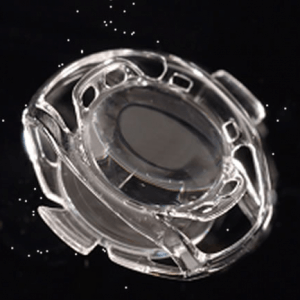
“The engineers at LensGen® have developed a biomimetic device with the inherent ability to change curvature similar to the natural human lens. In doing so the team at LensGen® has taken the next step forward in developing a superior and breakthrough technology in the surgical treatment of cataracts and presbyopia.”

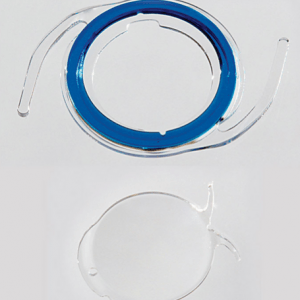
This patented Technology is based on a monofocal lens that has a curvature changing fluid compartment that actively changes shape. A Modified Ring is placed into the capsule and the optic is then inserted separetely.


Lenstec Tetraflex HD

Very Soft Material, amenable to flexure with ongoing bag construction post op !

Lumina Dual Optic IOL (Akkolens International)

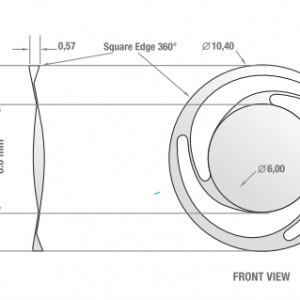
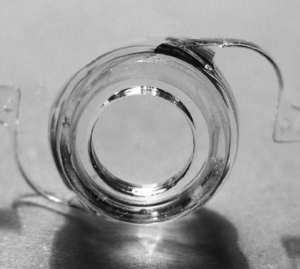
The Lumina AIOL (AkkoLens International, Breda, The Netherlands) consists of 2 optical elements, capable of moving one on top of the other, and is implanted in the ciliary sulcus The lens is manufactured with an acrylic hydrophilic polymer material. The optics provides a fixed optical power: the anterior element is designed to provide 5 D while the posterior provides between 10 to 25 D, depending on the correction needed for the patient after the lens removal. Each one of the optics has an internal aspheric surface where its power increases linearly when the lens moves. Therefore, when the eye accommodates and the ciliary muscle contracts, the optics of the lens change their longitudinal position, passing one over the other thereby resulting in an increase of the dioptric power of the lens, focusing the light for the near distance and providing accommodation to the patient. J Alio et al, 2017


Nulens Dynacurve IOL (Nulens ltd)

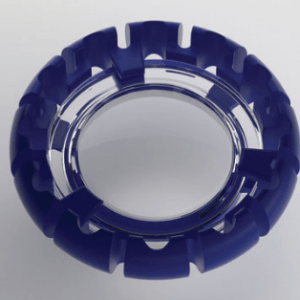
The NuLens Dynacurve accommodative IOL (NuLens, Ltd., Herzliya Pituah, Israel) consists of: 1) polymethyl methacrylate (PMMA) haptics that are designed to be placed in the ciliary sulcus; 2) a PMMA anterior reference plane that provides distance vision correction; 3) a small chamber containing a solid silicone gel and 4) a posterior piston with an aperture in the center.

Such IOL prototypes, even with silicone gel of a relatively low refractive index (1.40), have been shown in a primate eye to deliver more than 40.00 D of accommodation using only 500 µm of vertical diaphragm displacement. No wonder the principle was evaluated clinically in AMD Patients, providing additional evidence regarding the Concept of possible extreme Accommodation. This Prototype of lens required a 9mm incision to be inserted in the sulcus/bag.


Sapphire IOL (Elenza)


The Sapphire IOL (Elenza) is electronically controlled, remotely programmable, customisable and utilises nanotechnology, artificial intelligence and advanced electronics to auto-adjust focus in response to pupillary changes. Speed and amplitude of pupillary responses are used to differentiate between light and accommodation. The power-cell requires recharging every three-to-four days, has hibernation mode and a fail-safe mechanism that converts it to monofocal status till recharged.

First announced in 2011, Many Prominent Ophthalmic Surgeons in the directory Board of Elenza, One of the two probable  current “electronic IOL” .


Synchrony Dual Optic IOL (J-J-Visiogen)


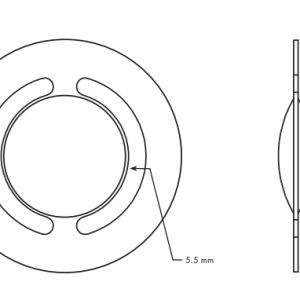
The Synchrony IOL (Visiogen, Abbott Medical Optics, AMO, Santa Ana, Calif.) was a single-piece dual-optic, silicone lens designed to mimic the natural lens. It had a 5.5 mm high plus anterior optic of +32 D, coupled to a 6.0 mm negatively powered posterior optic. The concept is that these two lenses are separated by a spring-activated mechanism. The haptics separate the lenses at a given distance under constriction of the capsule, and during relaxation of the capsule following accommodative effort, anterior movement of the positive anterior optic produces increased power for near tasks.

Source: https://www.eyeworld.org/

Trulign Toric IOL (model BL1UT)) Bausch+Lomb

Based on the Crystalens Platform -Embedded Polymide haptics into the hinged Silicone Plate of the IOL. B+L will supply AT50T (Spheric Toric  Optics) or aspheric Optics  (BL1UT) This Lens has better UV coverage then previous model (BL1AT)

Vista Lens (Vista Ocular)


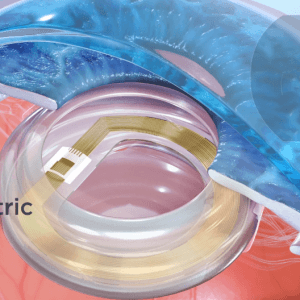
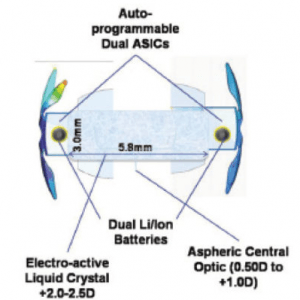
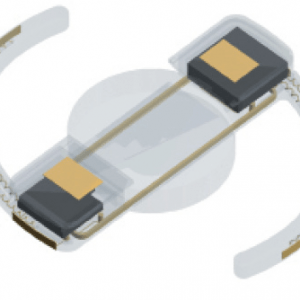
Vista Ocular (Ohio, US), is developing an innovative technology to bypass pupillary and ciliary muscle movement, and target the muscle’s action potential as the accommodative signal. The technology is patented and more patents are pending. The company is currently in the process of testing an in-vivo sensor system for the detection of the ciliary muscle’s action potential. This design also incorporates rechargeable battery power with a flexible lens system to change optical power in a variable fashion (Figure 3). Along with Elenza are the 2 US based start-ups that aim to develop a electronic IOL